
AI in Action
Watch the panel discussion around AI initiatives and a feasibility value matrix with DatascaleHR and Siemens Energy, alongside our trusted partner Cape.
Built for the Agentic Enterprise
One governed foundation. Every person, every agent, every process.

More AI investment often leads to more disconnected tools. The stack keeps growing. The gaps stay open.
Mendix closes those gaps.
Closing those gaps does not require replacing what you have built. Mendix runs on top of the infrastructure, data, and tools you already have. It connects them, coordinates them, and enforces governance across all of it.
Trusted By


Mendix is built around five integrated capabilities. Each one closes a gap between AI investment and business return. There’s only one platform that enables you to close all five gaps.
Build shared enterprise understanding across every system: ERP, CRM, OT, and beyond. Agents and humans need the same version of reality.
Explore Enterprise Knowledge GraphDeliver AI grounded in your operations. Generic models don't know your enterprise. Custom models produce outputs people and agents can act on.
Explore AI Model DevelopmentDesign solutions and agents for the hybrid workforce on a single foundation. The right agent acts. The right human steps in with the context they need.
Explore Agentic DevelopmentA signal anywhere in the enterprise triggers coordinated action across every part of the enterprise as one traceable end-to-end process.
Explore Process OrchestrationBuilt in from day one instead of layered on later. Every action is traceable. Every decision is auditable. Be ready before anyone asks.
Explore Enterprise AI Governance
Agents and people on the same page
Every enterprise runs on data spread across dozens of systems. No single system sees the whole picture. This is exactly where agents fail.
Graph Studio builds an enterprise knowledge graph across every system you already run without moving, copying, or replicating a single record. It maps not just what your data contains, but how every entity, relationship, and domain connects to every other, across your full enterprise ontology.
That picture is what makes agents reliable. Every model and solution on the platform reasons from the same context, traces every answer back to its source, and acts without rediscovering what your enterprise already knows. Domain expertise gets encoded into the graph itself, not locked inside the people who understand it, so institutional knowledge scales with your workforce, not against it. Auto-generated ontologies and composable graphmarts mean no months of upfront modeling, and no rebuilding what already works when you add new domains. Teams are up and running in weeks, not years.
AI grounded in your operations
Generic AI models are not built for the complexity of your unique workforce and processes. The jobs that matter most in operations, like predictive maintenance, anomaly detection, root cause analysis, and risk scoring, require models trained on your data, grounded in your context, and built to reach production and stay there.
Building and deploying those models requires closing the execution gap: getting from development to production without losing the business knowledge, transparency, or governance that make AI decisions actionable. Domain experts and data scientists work together across the full model lifecycle on the same platform, from prototype through deployment, so the people who understand the problem stay involved through delivery.
Models deploy as governed API endpoints, accessible to any agent workflow on the platform. Integrated drift monitoring and continuous performance tracking mean models stay accurate over time, not just on launch day.


Agents and people, working together
AI projects fail to deliver value or remain stuck in the pilot stage because they’re simply not production-ready. The bottleneck shifts downstream, and the cost of fixing it grows.
With Mendix, teams build and deploy traditional web and mobile solutions as well alongside AI agents and agentic solutions that handle real operational complexity from day one.
Maia, the agentic AI built into the platform, plans and builds on your organization’s real context, from its architecture, guidelines, standards, and approved components. Maia Make executes multi-step development autonomously, from requirements to working software. AI generates into visual models, not raw code, so anyone who understands the problem can contribute to the solution without specialist skills at every stage.
The result is working software delivered faster, with less back-and-forth and less rework. From a single use case to the full enterprise portfolio, on the same platform from day one.
One signal, enterprise-wide action
An RPA tool here. An iPaaS platform there. A workflow tool for each department. The average large enterprise now runs automation across dozens of disconnected systems. Add AI agents on top of that fragmentation and the result is processes no one fully owns and agents no one fully governs.
The platform’s process orchestration capabilities solves that. A supplier alert, a risk threshold breach, a case falling outside its SLA. Each one should trigger coordinated action across every function it touches. With Mendix, you create a single layer that connects business events, AI signals, and human decisions across the entire enterprise, coordinating agents, systems, and people simultaneously as one governed process.
Every step visible. Every handoff accountable. Every action traceable from trigger to outcome.


Scale AI with confidence
Most enterprises govern by exception. When running an agentic enterprise, that model does not scale. It’s fertile ground for shadow AI, growing compliance backlogs, and stalled out production lines.
Within the platform, governance starts from the point of creation. Enforce policies centrally across every app, agent, and workflow, not per team, not per project. Everywhere. Every model inference, agent decision, human approval, and data lineage event is traceable, logged, and auditable before anyone asks for it.
As the portfolio grows, governance absorbs the complexity rather than creating it. New apps and agents inherit the same enforcement layer automatically. You get built-in audit trails, explainability, and policy controls.

Even when AI works technically, companies fail to capture value if they do not redesign workflows, roles, and governance for humans and AI to work together.
MIT BCG

Datascalehr is a platform-as-a-service (PaaS) that uses AI and ML to connect any data source to any payroll and reconcile them. They adopted Mendix to launch its AI-native platform and transform payroll software.
Their platform’s model solves a decade-long challenge of multi-country payroll operations by establishing the right connectivity to their client’s data and payroll partner network, eliminating the need for code maintenance and reconciliations.
Features include real-time tracking and validation, data synchronization across ecosystems, and continuous monitoring, enabling its customers to focus more on problem solving and less on technical execution.


We are seeing a trend in the market where AI agents are going to play a significant role in automating workflows or helping collaboration between users. I always felt Mendix was at the cutting-edge of the technology changes that are happening, and integrating AI agents into workflows is one area where I feel that we can collaborate with Mendix.
Venky Yerrapotu Co-Founder and CEO, 4CRisk


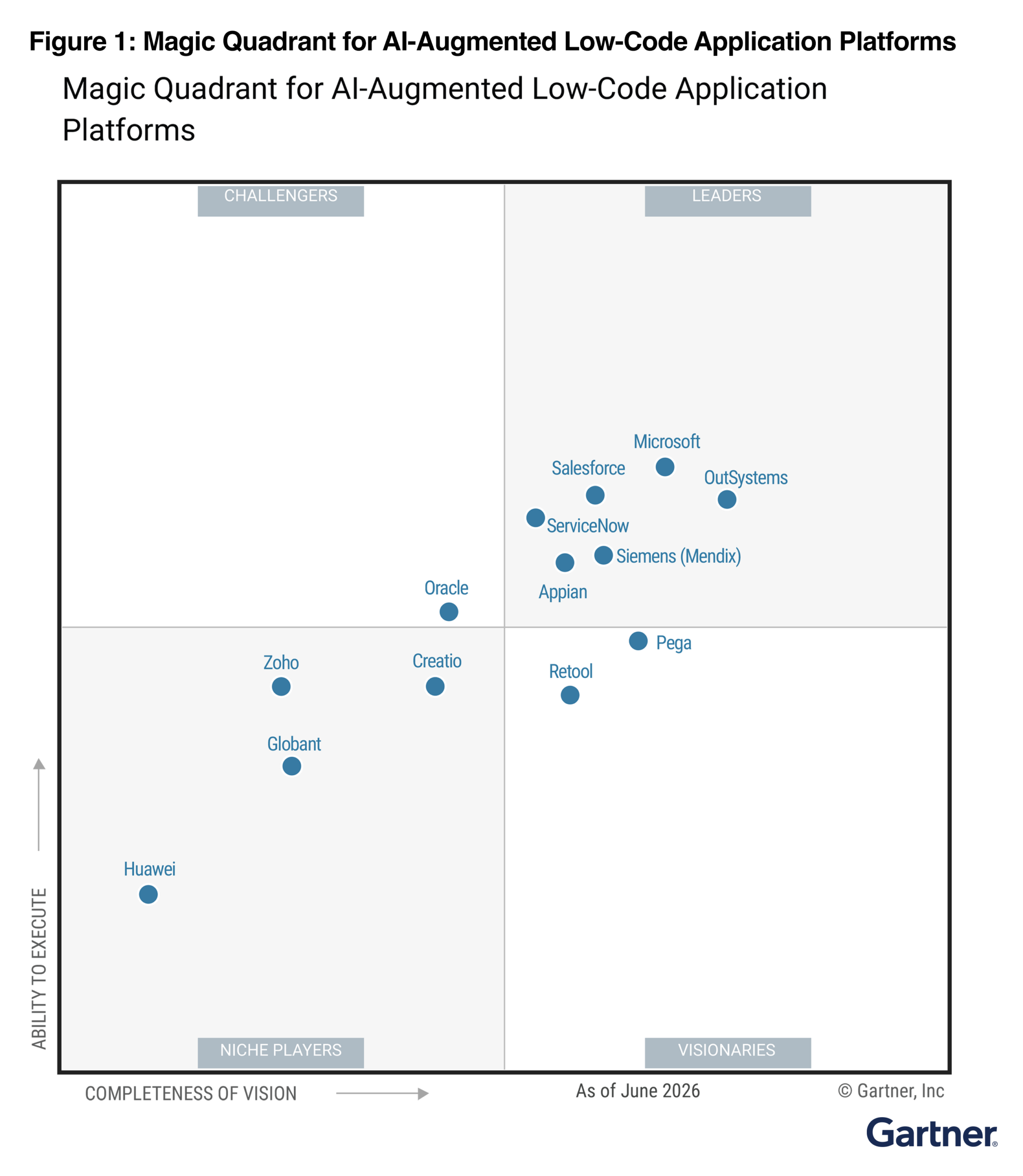
Mendix has been a Leader in the Gartner® Magic Quadrants™ for AI-Augmented Low-Code Application Platforms for a decade straight.
The bottleneck is rarely due to the model. It is the absence of enterprise context: the semantic relationships, business logic, and cross-system meaning that tell an agent what actually matters in your organization. Data lakes and LLM integrations do not provide that.
It’s necessary to find a platform that addresses the root cause by building a live knowledge graph that connects every enterprise system into a unified ontology agents and people can reason across, without replacing what you have already built.
Up to five things, in most cases. 1. Enterprise context that gives agents a shared understanding of how the organization actually works. 2. Intelligence grounded in your operational data, not generic models. 3. Coordination that brings people and AI agents together by design, not as an afterthought. 4. Orchestration that connects action across every function simultaneously as one traceable process. 5. Governance enforced at the point of creation rather than added afterward. Most enterprises have invested in one or two of these. Mendix provides all five in a single architecture.
No. The knowledge graph is built on top of your existing data estate, adding the semantic context that data lakes and cloud platforms do not provide on their own. No migration required, no source systems replaced.
It connects to existing systems, like ERP, CRM, OT, financial, or supply chain without replacing them. The knowledge graph sits on top of your current estate. You do not need to rebuild your stack or move your data to deploy at scale.
The low-code environment lets business and IT teams collaborate to deliver production-ready applications and AI agents without data science expertise or additional headcount. As an example, Brazilian glass manufacturer, Vivix, deployed 17 production applications in one year using an existing team, no new data science hires.
The platform’s architecture is designed to hold up under regulatory scrutiny in highly regulated industries like financial services, healthcare, manufacturing, and the public sector.
It’s right to be concerned about shadow AI. Mendix gives IT the governed infrastructure that business teams are currently working around. When it is fast enough and accessible enough for business and IT to build together, the incentive to go outside governance disappears.
Mendix gives you centralized policy enforcement, full auditability, and a low-code environment that does not require specialist expertise to close the gap between what IT can govern and what the business wants to build.
Start building for your agentic future. Complete this form and we'll be in touch soon.