3 Ways AI governance Helps Teams Move Faster in the Right Direction

- October 8, 2026
- minute read

Key highlights
- A successful AI pilot still needs a path through data access, validation and approval before it can run reliably in production
- Shared controls reduce the work development teams repeat for each new application or agent
- AI governance via visible workflows, model flexibility and human approval points help organizations scale AI with accountability
As more companies move to deploy AI solutions, it’s worth remembering: speed is useless if you’re moving in the wrong direction. Said another way: a fast AI pilot has little value if it never makes it into production.
Some problems with AI prototypes are easy to miss during a controlled test. Instead, the harder questions around access, output quality, ownership and review tend to arise once the team tries to connect it to company data.
It is during that transition between pilot and deployment that AI projects often come to a halt, after the wider organization introduces constraints the pilot did not encounter.
This is precisely the problem AI governance is meant to solve. By giving developers clear rules for access, validation and oversight as they build, AI governance improves the chances of a promising prototype becoming a system the organization can trust and use to create long-lasting value.
Building fast comes at a cost
Mendix customers say that AI lets them develop applications more quickly than low-code or traditional development. But those teams also describe the time they spend setting up and maintaining quality checks, security controls, deployment processes and maintenance standards.
When each new project needs its own controls, that work can consume a significant amount of time that was initially saved during development. Nothing from the last project carries forward, and review work is inevitably repeated.
Teams also need to account for risks that notoriously complicate deployment and make the maintenance of an application harder than it should be. These include:
- Decisions that cannot be traced or investigated
- A heavy dependence on one model provider that complicates a future change
- An agent with no defined point for human review may take consequential actions without approval
Addressing these risks head-on with AI governance gives development teams a clearer path to production and helps to translate AI investments into measurable outcomes.
According to PwC, 74% of AI’s economic value is captured by just one-fifth of organizations. The companies in that 20% are about three times more likely to let AI make decisions on its own, and they go furthest on governance. PwC’s research also shows that those AI leaders are top performers not because they simply deploy more AI tools, but they focus on building strong foundations around data, governance and trust.
The real competitive advantage with AI is staying power; something that speed without governance cannot offer.
Governance is the underlying mechanism that makes the pilot-to-production leap possible, and it’s what lets agentic initiatives expand with credibility instead of stalling at every review. Here are three ways to address the risks with AI governance.
1. Make the workflow and its evidence inspectable
Ask a development lead if they can verify that everything produced during development was reviewed before production, and the answer is often some version of, “I think so, but I can’t validate it.”
This becomes a significant concern for organizations whose policies require explicit validation.
To remedy this, teams need to make application logic, permissions, validation steps, and approval points visible to the people responsible for them. They should also record who reviewed an artifact and when. If an AI-driven outcome is challenged later, traces of the relevant model interactions and tool calls can help the team investigate what happened.
That way, when something goes wrong, there is a name and a record, and evidence of review at every stage. Audits become a matter of retrieval rather than reconstruction.
2. Keep model choice flexible
An organization’s needs are rarely, if ever, fixed. As those needs evolve, the model best suited to the job may change.
Teams should be able to evaluate another provider without rebuilding the application’s business workflow. They also need an agreed process for testing and approving a replacement, including its output quality, data handling and effect on users.
With this in mind, Mendix supports connections to multiple AI models, giving teams room to change providers as their requirements evolve. When governance sits above the layer that changes, policy only has to be defined once. Teams can carry established controls forward to assess what a new model or deployment changes.
3. Set boundaries for agents and approval points for people
Grounding an agent in organizational data can expose information through its responses if access is not carefully controlled. This means that an agent’s access to company information should receive as much attention as the actions it can take.
Before deployment, teams should clearly define which data the agent may use, which actions it may complete, and which decisions require a person to step in.
Consider an agent that reviews a request and prepares a recommendation. It can gather permitted information and draft a response. But before it updates a critical system, the workflow pauses for a named employee to validate and approve its work. That decision is recorded for audit.
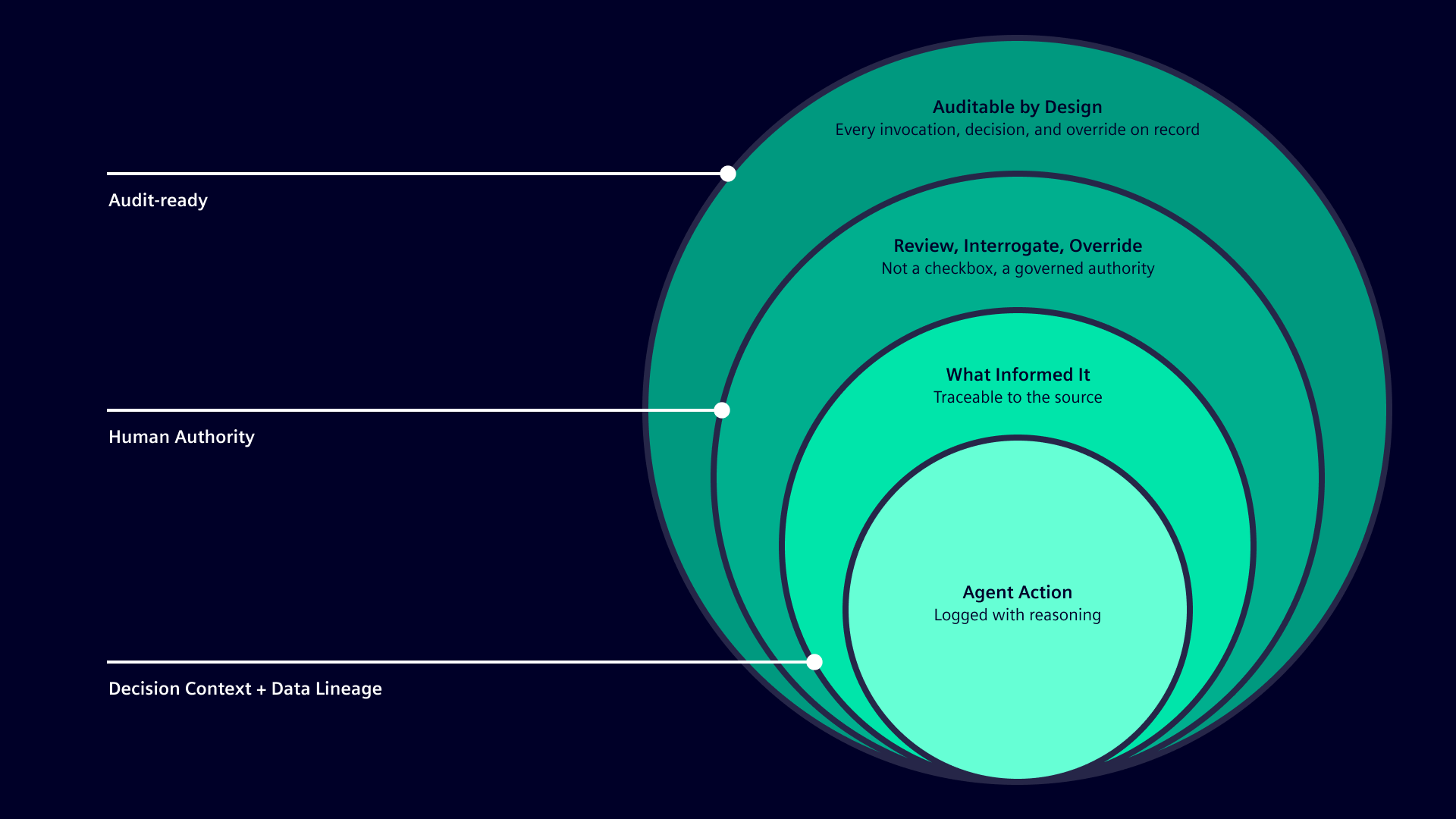
In Mendix, teams can configure human review as a required step in an agent workflow, so the process cannot proceed until approval is given.
Make the next deployment easier to govern
Getting a development platform tested, validated and secured takes time, but Mendix customers have experienced that payoff when they scale out with 10+ applications that they need to manage. Those applications draw on controls and assurance established at the platform level with Mendix. This means that far less foundational review is required for each new project.
Shared controls give developers a consistent starting point and evidence of how the rules were applied. Mendix is designed to carry centrally defined governance across applications, agents and workflows as the portfolio grows.
To assess whether your own approach can keep up, ask: Can your team demonstrate that everything it produces was validated before production? And can it continue to do so as AI increases the volume of work?
Enterprise AI Governance | Siemens | MendixFrequently Asked Questions
-
What is AI governance?
AI governance is a strategic framework that establishes clear rules for data access, validation, and oversight, ensuring that AI initiatives evolve into trusted systems that deliver measurable business value. With AI governance implemented, organizations can accelerate delivery cycles while providing a consistent, reusable foundation that eliminates repetitive security and compliance work. This approach creates a secure and scalable environment where AI agents operate with full accountability, ensuring that rapid innovation remains aligned with long-term enterprise standards.
-
Does governance slow down the development process?
Although commonly perceived as a bottleneck, governance serves as an accelerator by providing standardized guardrails that prevent teams from repeating foundational work for every new project. This model allows for faster backlog clearance and reduces the long-term maintenance burden by building on a pre-validated, high-quality foundation. By addressing these requirements upfront, organizations ensure that initial development speed translates into successful production deployments without being stalled by late-stage security or architectural reviews
-
Why do AI pilots stall before going to production?
AI pilots often fail to reach production because they lack the robust data access, validation, and approval workflows required to operate reliably at scale within an enterprise ecosystem. Without these foundational elements, projects often encounter unforeseen constraints and untraceable decision-making paths that make them too risky or difficult to maintain. When decisions are not trusted or are constrained, users are reluctant to accept the AI pilot into their day-to-day. Addressing governance at the start ensures that prototypes are built to solve these enterprise-grade challenges early, creating a clear path from experimental pilot to a secure, scalable, and value-generating system.
-
What are the biggest risks in deploying AI applications?
The primary risks in AI deployment involve untraceable outcomes, heavy dependencies on single model providers, and the potential for autonomous actions to occur without necessary human oversight or data boundaries. These issues can lead to significant technical debt and create security vulnerabilities that undermine the long-term scalability of the AI portfolio. Organizations can mitigate these risks by utilizing a platform that enforces visible workflows and model flexibility, ensuring that AI investments provide a sustainable competitive advantage.