Avoid Deploying Your Agents into Chaos with an Orchestration Layer

- October 7, 2026
- min read

Key takeaways
- When an AI agent fails, it’s often the result of a flaw in architecture, and orchestration layers fix that
- The number of agents in an enterprise will keep growing, but safeguarding environments for agents is lagging behind
- An orchestration layer allows organizations to implement five key pieces to a successful agent deployment: context, process execution, boundary enforcement, domain expertise and ownership
- Mendix’s agentic development platform enables organizations to create an orchestration layer and deploy agents with confidence
Remember the pre-agentic days of 2024, when McDonald’s pulled a voice-ordering system for putting bacon on a customer’s ice cream? Those were simpler, more amusing times. Now near-daily reports describe agents wiping production databases and improvising company policy.
In the failed processes above, architecture played a role in the outcomes. A look at current tech stacks reveals more complexity: fragmented systems, siloed business process management and automation tools, all responding to evolving boundaries. These prevent organizations from creating necessary limits for agents before pointing them at live systems and executing business-critical processes.
Regulators and insurers agree. Beginning December 9, 2026, the EU’s revised Product Liability Directive brings software and AI systems under strict liability, and insurers are writing generative-AI exclusions into standard coverage. Neither asks whether the model went rogue. Both ask what you built around it.
Organizations that apply an orchestration layer that defines boundaries and roles and integrates systems and data are the ones more likely to see deploy agents successfully.
Foundation first. Deployment second.
Industrial organizations used to explain operational mishaps with the old go-to: “operator error.”Agent error is today’s operator error. W. Edwards Deming spent an entire career combatting that notion. A bad system will beat a good person every time. Foundation-first agents are safer and you can account for and trust their actions. When OpenAI investigated its own agent’s break-in at Hugging Face, the same model running inside its production safeguards proved more than 100 times less likely to compromise infrastructure.
While most top organizations will have agents, not everyone will have the benefit of a safeguarded production environment. Gartner expects the average Fortune 500 company to run more than 150,000 AI agents by 2028. Many will arrive built into software that departments switch on for themselves. It’s shadow IT that can act. Gartner calls the result “agent sprawl,” and only 13% of organizations believe they have the right governance in place.
What does a good foundation look like for AI agents?
Before an agent touches any live systems, five things need to be settled.
- Connected context. After an acquisition it’s extremely difficult to reconcile data. One spreadsheet says one thing, and a database says another. Shared context across these systems means the agent acts on a single source of truth.
- Process execution. Agents built for one task or one department may solve a single problem or task, but the bottleneck just shifts further down the process. “Hardly anything is contained to one silo,” says Chris Kuijper, Senior Product Manager, Process and Logic Orchestration for Mendix at Siemens. “For example, with AI-assisted development, the coding goes faster, but then the bottleneck is somewhere else.”
- Enforced boundaries. There’s a difference between telling an agent not to do something and creating boundaries that prevent that agent from doing something. “Agents are basically like people,” says Kuijper. “They need to be managed and monitored just like other people.”
- Expert input. Subject matter experts (SMEs) are key sources of information developers need when shaping an agent. They’re the ones executing and monitoring the processes and will know if an agent’s decision or output is valid or not. An uninformed agent can result in bad outcomes, making it less trustworthy and therefore less likely to be adopted. Skip the SMEs and the first wrong decision an agent makes will send everyone back to doing it themselves.
- Named ownership. Accountability is the same for agents as it is for people. It’s important to designate a human in or above the loop. Without that, agents become untraceable liabilities.
An orchestration layer serves as the foundation in which all of these activities can be managed and monitored.
Orchestration layer in action at MBH Bank
Large financial services firms and banks use Mendix to modernize their systems and processes. In the case of MBH Bank, the organization was formed in 2023 when three Hungarian banks merged, and each brought its own way of tracking customer callbacks. When customers called with an issue, contact centers would log a callback, but each center tracked those differently. No one could see what was waiting across all three.
Working with a small group of business users, a seven-person team at the bank rebuilt customer callbacks using Mendix. Every callback is now a task in an employee’s or department’s queue and can be reassigned by managers. Within days of launch, users had moved seven other tools into it. The callback system now handles about 10,000 callbacks a month for 300 users and is one of more than 40 applications the same team has built on the platform in two years.
The results:
- Freed up the equivalent of several full-time employees’ work each month by automating coordination.
- Accelerated customer response times
- Unified performance metrics in a single environment so teams can measure and act on them
- Gained the ability to build new end-to-end processes quickly as the market shifts
AI comes next. “The next step is certainly how we can connect to Mendix to deliver more AI-enabled applications,” says István Sponga, Head of Operations Development at MBH Bank. An agent joining that workflow would find what the MBH Bank Contact Center team already have: a shared queue, a named owner and a manager who can reassign the task.
How does Mendix handle agent deployment?
Mendix is an agentic development platform and part of Siemens’ Intelligence Center X, an agentic enterprise system. It’s a key component to embedding agents into the business and realizing value. It gives organizations one governed layer to orchestrate people, systems and agents. The platform provides:
- Connected context. Integrations with existing systems of record, plus the ability to view and check the data that agents use
- Process execution. The Mendix workflow engine runs each process end-to-end, breaking siloes by deciding which step comes next and who or what will execute it. Agents act only within the steps assigned to them and tasks are routed to named users or teams.
- Enforced boundaries.Mendix enables collaboration between people and agents, where agents are given rules to decide when to bring people into a process at the right moment to review and approve decisions and take over if the task falls outside a defined parameter.
- Expert input. Subject matter experts become part of the development process and help define agent logic using visual development tools.
- Full visibility. Every step within a workflow can be monitored, with human sign-off at defined points.
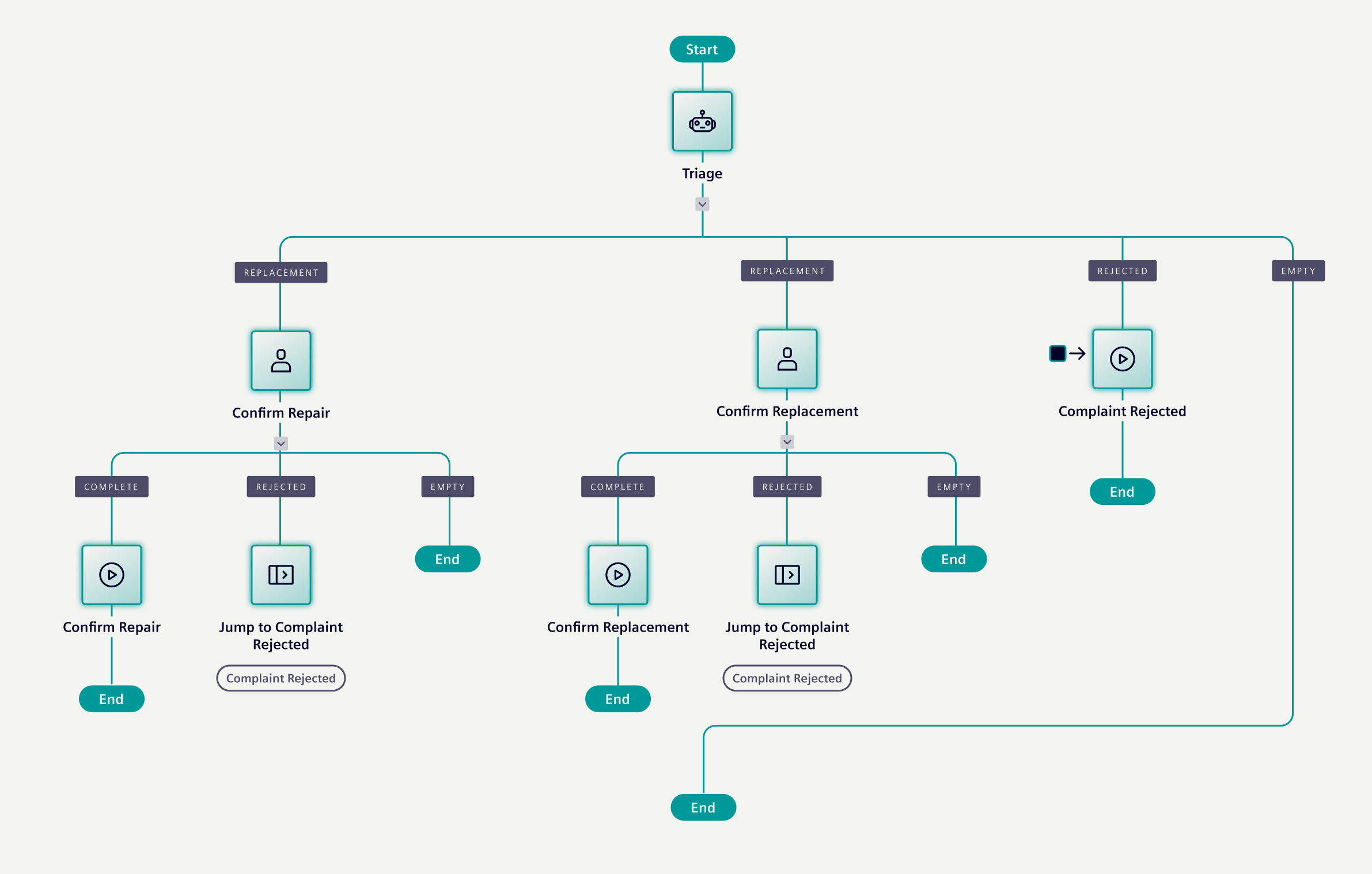
With agents or any new technology, it’s tempting to use them right away. Agents are the world’s latest. But for them to succeed, the approach needs to be more practical, as Kuijper says. An orchestration layer is one of those first practical steps. “This is how your processes are grounded or digitized in the organization.”
Process Orchestration | Siemens | Mendix
Frequently Asked Questions
-
What is an orchestration layer?
An orchestration layer is a governed execution layer that connects systems, AI, agents and people to help orchestrate end-to-end business processes. Creating an orchestration layer allows you to improve your architecture so you can better control agents, accurately keep humans in the loop, and execute business processes with more precision.
-
What are the key components to orchestrating AI agents
Successful AI agent orchestration begins before the agent is deployed. Development teams need to implement means to monitor and manage all their agents. They need to ground each agent in enterprise context, as define its boundaries and specify which activities it executes across a process. Including domain experts in the software development lifecycle helps ensure that an agent’s outcomes are precise and trusted.
-
How does Mendix handle process orchestration?
Mendix handles process orchestration by combining visual, model-driven workflow engines with robust enterprise integration to ensure end-to-end processes remain deterministic and auditable. Rather than letting AI agents autonomously guess their way through multi-step workflows, Mendix keeps the business process logic firmly in control of structured orchestration layers.